
Medical Lab Careers in NB: MLA vs MLT Programs Explained
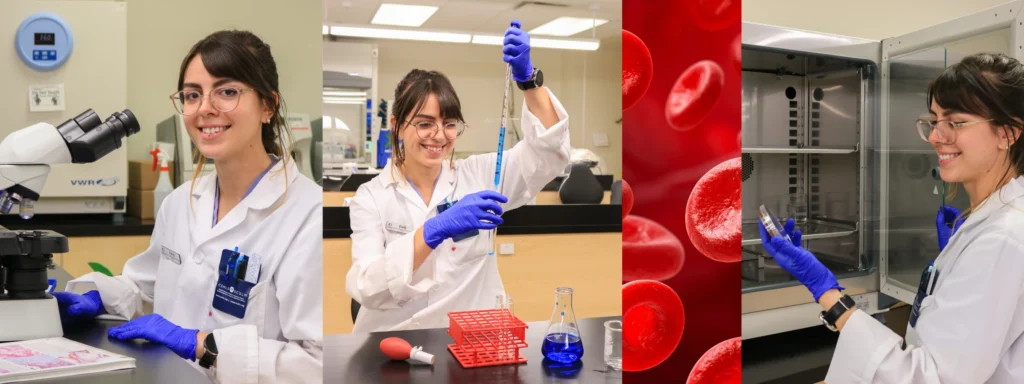
Ever wonder what happens during a routine lab visit, or who actually draws and tests your blood behind the scenes? While doctors and nurses often get the spotlight, it is medical laboratory professionals who perform the critical work behind over 70% of all physician diagnostic decisions in New Brunswick.
Whether it is a Medical Laboratory Assistant (MLA) welcoming you and performing a skilled blood draw, or a Medical Laboratory Technologist (MLT) operating high-tech equipment to analyze cells and detect disease, these two careers are the backbone of modern healthcare.
If you want a rewarding, high-demand career in health sciences without spending four to eight years at university, laboratory medicine offers two fast, powerful entry points.
While both roles keep our healthcare system running smoothly, they involve distinct daily responsibilities, training lengths, and salary ranges. Choosing the right path comes down to your personal strengths, timeline, and long-term career goals. In this guide, you will learn the exact differences between MLA and MLT roles, salary expectations, career advancement opportunities, and how Oulton College can help launch your dream career in New Brunswick.
Who Does What? Understanding Medical Laboratory Roles
To understand how a medical lab operates, imagine a high-precision relay team.
The Medical Laboratory Assistant (MLA) takes the first leg of the race. They are often the frontline face of the laboratory. An MLA greets patients, collects blood samples (phlebotomy), and prepares tissue or fluid specimens so they are ready for complex testing. Without MLAs, the lab flow grinds to a halt.
The Medical Laboratory Technologist (MLT) takes the handoff. An MLT is the scientific detective who operates complex computerized analyzers, analyzes cell structures, identifies bacteria under microscopes, and cross-matches blood types for life-saving transfusions.
Both roles are vital to modern medicine, but they focus on different parts of the diagnostic process.
MLA vs MLT Daily Duties:
While both professionals work in lab environments like hospital systems or private diagnostic clinics, their day-to-day duties require different levels of specialized skill.
Primary Duties of a Medical Laboratory Assistant (MLA)
- Patient Interaction: Performing venipunctures (blood draws) on patients of all ages.
- Specimen Processing: Sorting, centrifuging, labeling, and barcoding blood, urine, and tissue samples.
- Lab Maintenance: Sterilizing equipment, maintaining inventory, and preparing chemical reagents.
- Administrative Tasks: Data entry, receiving lab requisitions, and routing samples to specific laboratory departments.
Primary Duties of a Medical Laboratory Technologist (MLT)
- Diagnostic Testing: Running quantitative and qualitative tests across major lab disciplines: Hematology, Clinical Bio Chemistry, Microbiology, Transfusion Medicine, and Histology.
- Microscopic Analysis: Identifying pathogenic bacteria, abnormal blood cells, or parasitic infections.
- Quality Assurance: Calibrating high-tech automated equipment and verifying that test results are mathematically and biologically accurate before releasing them to physicians.
- Critical Value Reporting: Contacting doctors directly when test results reveal life-threatening medical emergencies.
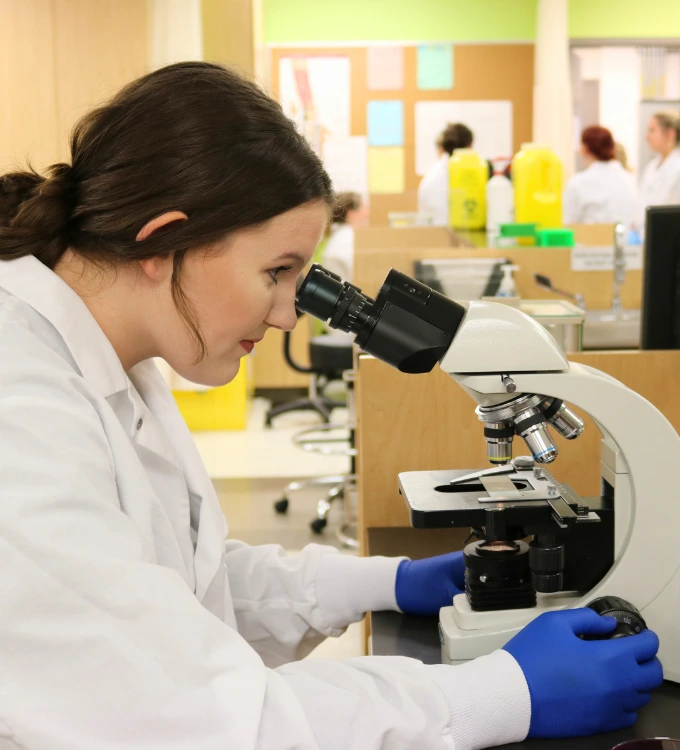
Finding Both Programs Under One Roof: The Oulton Advantage
If you are looking to pursue medical laboratory technology NB training or become a medical laboratory assistant NB, finding an institution with hands-on labs and strong employer connections is essential.
Located in Moncton, New Brunswick, Oulton College offers both programs under one roof, providing students with simulation facilities and high post-graduation job placement rates.
The Medical Laboratory Assistant (MLA) Program
- Duration: Fast-tracked 10-month program.
- Credential: Diploma.Highlights: Features intensive hands-on lab training on campus followed by a 5-week clinical practicum in a real healthcare setting.
- Best For: Individuals who want to enter the workforce quickly with lower upfront tuition costs.
The Medical Laboratory Technology (MLT) Program
- Duration: Accelerated 2-year diploma program.
- Credential: Diploma accredited by Accreditation Canada (EQUAL Canada).
- Highlights: Features simulation lab practice and 11 weeks of hospital placement. It prepares graduates to challenge the Canadian Alliance of Medical Laboratory Professionals Regulators (CAMLPR) national certification exam.
- Best For: Students who love chemistry, biology, and problem-solving, and who want higher earning potential and broader career advancement.
Oulton Advantage: Oulton’s MLT program boasts a 96% placement rate. Because both MLA and MLT students train in high-tech simulation labs, graduates enter their clinical placements with real-world confidence.
Salary Differences: What Can You Expect to Earn?
Because a Medical Lab Technologist carries a higher level of analytical liability, this role requires a longer period of study to master in-depth theory across multiple departments. Resulting in a broader, more specialized expertise, their compensation reflects that advanced responsibility.
According to healthcare wage benchmarks in New Brunswick, the average pay for a qualified MLT hovers around $35.00 per hour, depending heavily on experience and shift differentials. Specialized technologists working in major hospital networks or specialized labs can see annual salaries climb.
Because a Medical Lab Assistant position requires less academic study, the starting pay reflects that baseline. In New Brunswick, MLAs typically earn between $23.00 and $29.00 per hour.
While the starting income is lower than a technologist salary, the lower financial cost of tuition and the ability to start earning a reliable healthcare income in less than a year makes it an incredibly attractive option for many prospective students.
Career Growth and Long-Term Mobility
When choosing between MLA vs MLT, think about where you want your career to lead five or ten years from now.
- MLA Career Progression: Assistants can advance into lead phlebotomy positions, laboratory operations coordination, quality control assistance, or administrative management roles within health networks. Many MLAs also use their experience as a stepping stone toward becoming an MLT later in life.
- MLT Career Progression: Technologists have vast room for specialization. With experience, MLTs can specialize in advanced fields like Molecular Diagnostics or Cytotechnology, move into Senior Technical Lead roles, become Laboratory Managers, or work in medical sales and field application engineering for global medical device companies.
Which Path Is Right for You?
Ask yourself these quick questions to help decide which career path aligns with your lifestyle and goals:
Choose Medical Laboratory Assisting (MLA) if:
- You want to start working in healthcare in less than a year.
- You don’t mind face-to-face patient contact and hands-on specimen collection.
- You prefer a fast, direct path into the workforce with lower tuition expenses.
Choose Medical Laboratory Technology (MLT) if:
- You love deep scientific analysis, microscopy, and solving medical mysteries.
- You are comfortable committing to a rigorous 2-year accredited program.
- You want higher long-term earning potential and greater clinical autonomy.
Main Takeaway
New Brunswick needs qualified lab professionals across the province.
Whether you choose to jumpstart your career in 10 months as an MLA or dive into a 2-year MLT diploma, both roles offer job security, high demand, and the pride of knowing you save lives behind the scenes every day.
Ready to turn your passion for science into a fulfilling healthcare career? Take the next step by exploring the accredited Medical Laboratory programs at Oulton College today!

Turn Compassion into a Career.
Are you ready to make a difference in the medical field?
Can I upgrade from an MLA to an MLT later in my career?
Yes! Many students begin as Medical Laboratory Assistants to enter the workforce quickly and gain hospital experience. Later, they return to complete an accredited Medical Laboratory Technology program to advance their skills and increase their earning potential.
What is the main difference in training duration between MLA and MLT at Oulton College?
The MLA program is an accelerated 10-month course focused on specimen collection, safety, and lab preparation. The MLT program is a comprehensive 2-year diploma that includes detailed study of microbiology, hematology, and transfusion science, along with extensive clinical placement hours.
Do Medical Laboratory Technologists need certification to work in New Brunswick?
Yes, after completing an accredited MLT diploma program like the one offered at Oulton College, graduates write the Canadian Society for Medical Laboratory Science (CSMLS) national exam to become certified technologists eligible for employment across NB and Canada.
*Please note that information may be subject to modifications. We encourage current and prospective students to visit the websites and speak to Admissions Advisors, in order to obtain the most recent information.