
7 Game-Changing Study Habits Every College Student Needs to Master

Have you ever spent hours staring at a textbook, re-reading the same paragraph five times, only to realize you have no idea what you just read? You are not alone. Transitioning to college academic expectations can feel like being tossed into the deep end without a life jacket. The workload is heavier, the deadlines come faster, and the old high school trick of cramming the night before an exam suddenly stops working.
The good news? Academic success is not an innate talent you are born with. It is a set of skills you can learn. By replacing passive habits with active strategies, you can reduce study stress and achieve better grades in less time.
In this article, you will learn 7 science-backed study habits that help college students thrive, along with practical ways to leverage your campus support systems to make your learning journey smoother.
The Science of Studying: Why Smart Habits Matter
Many students believe that getting good grades simply requires studying longer hours. However, research shows that how you study matters far more than how long you study.
A study on student performance and learning behaviors published in the International Journal of Environmental Research and Public Health found that active learning strategies and structured time management directly correlate with higher academic performance and reduced mental stress. Conversely, marathon cramming sessions increase cortisol levels, impair memory retrieval, and lead to early burnout.
When you adopt proven study tips for college students, you work with your brain’s natural cognitive processing rather than fighting against it.
7 Proven Study Habits for College Success
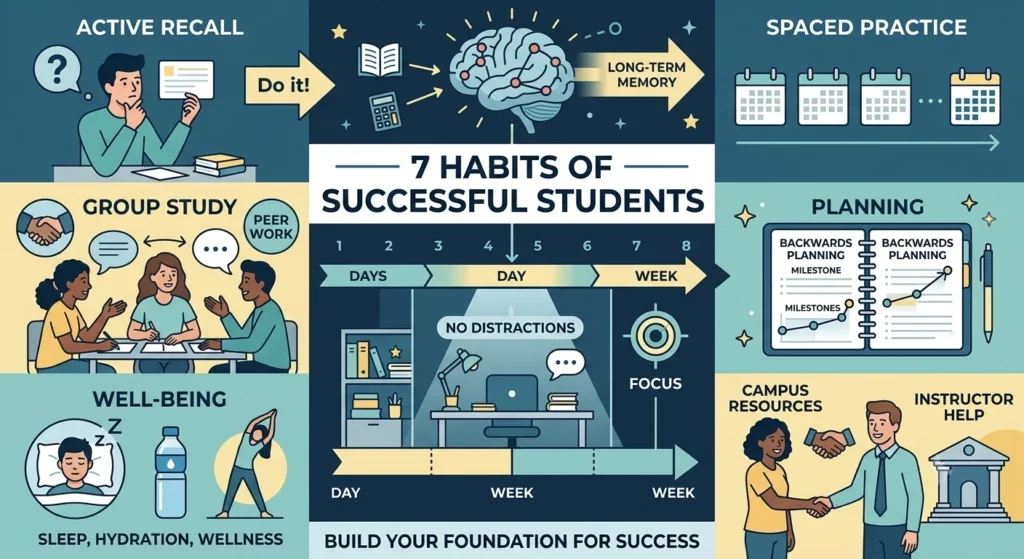
1. Ditch Passive Recall for Active Recall
Highlighting lines in a textbook feels productive, but cognitive scientists call this an “illusion of competence.” You recognize the text, so your brain tricks you into thinking you have mastered it. Instead, practice active recall. Close your book or notes and force your brain to retrieve the information from memory.- Flashcards: Write a concept on the front and test yourself without peeking at the back.
- The Feynman Technique: Explain a complex topic out loud in simple terms, as if you were teaching it to a beginner.
- Practice Questions: Answer end-of-chapter questions or create your own quiz items.
2. Space Out Your Study Sessions (Spaced Repetition)
Cramming for seven hours the night before a test stores information in your short-term memory, where it quickly evaporates. Spaced repetition involves spreading your review over several days or weeks in shorter bursts. Day 1: Learn new material in class Day 2: Review notes for 15 minutes Day 4: Self-test using flashcards for 10 minutes Day 7: Complete a practice problem set According to research on cognitive retrieval and the psychological “spacing effect,” reviewing material at expanding intervals dramatically reduces the rate of forgetting and embeds knowledge into long-term memory.3. Master the Pomodoro Technique for Focus
Deep concentration is a muscle. If you try to study for four hours straight without a break, your focus naturally degrades. The Pomodoro Technique breaks your work into manageable, high-intensity intervals:
- Choose one specific task.
- Set a timer for 25 minutes and work with zero distractions.
- Take a 5-minute break to stretch, hydrate, or step away from your screen.
- After four cycles, take a longer 15 to 30-minute break.
This method keeps your mind fresh and prevents mental fatigue from setting in halfway through your afternoon.
4. Create an Environment Designed for Attention
Willpower is a limited resource. If your phone is sitting next to your notebook buzzing with notifications, you are burning mental energy constantly resisting the urge to check it.
Design an environment that minimizes friction:
- Keep a dedicated study space that is clean and quiet.
- Place your phone in another room or turn on a strict focus mode.
- Keep all necessary supplies, like notebooks, pens, and water, within arm’s reach before you sit down.
When your environment supports your goals, staying focused requires far less effort.
5. Build Organizable System with Backwards Planning
College assignments often have multiple moving parts. Waiting until three days before a major paper is due creates unnecessary panic.
To stay ahead, use backwards planning:
- Note the final due date on your calendar.
- Break the project down into smaller, actionable milestones (e.g., research, outline, rough draft, editing).
- Assign target completion dates for each milestone, working backward from the deadline.
This approach keeps large projects manageable and ensures continuous progress without last-minute chaos.
6. Study with Purpose in Small Groups
Studying alone is necessary for deep focus, but peer collaboration can fill in learning gaps and boost motivation. When forming a study group, keep it focused:
- Limit the group to 3 to 5 people.
- Assign specific topics or questions to cover before meeting.
- Use the time to test each other, debate solutions, and clarify confusing points.
Explaining a concept to a classmate is one of the fastest ways to solidify your own understanding.
7. Prioritize Sleep, Hydration, and Stress Relief
You cannot out-study a neglected body. Sleep is not downtime; it is when your brain consolidates memories from the day. Skimping on sleep directly harms your ability to recall facts and reason logically during exams.
Aim for 7 to 9 hours of quality sleep each night, drink water throughout your study sessions, and move your body daily. Physical well-being forms the foundation for true student success.
How Campus Support Systems Accelerate Student Success
Even with the best study habits, every student runs into academic or personal hurdles at some point. Knowing when and where to seek help is just as important as studying hard.
For instance, institutions like Oulton College structure their whole learning environment around student support. Here is how campus resources can elevate your study routine:
- Small Class Sizes: Unlike massive university lecture halls with hundreds of students, smaller class environments make it easy to ask questions, engage in discussions, and get personalized feedback.
- Accessible Instructors: Dedicated instructors who are approachable during office hours can help clarify difficult topics before you fall behind.
- Comprehensive Student Services: Accessing academic assistance, tutoring resources, and career planning early in the term keeps you on the right path.
- Mental Health & Wellness Resources: Academic success requires emotional well-being. Through partnerships like Oulton College’s connection to Homewood Health, students gain access to professional counseling and wellness services to navigate personal challenges, stress, and anxiety.
Taking advantage of these resources ensures you never have to navigate your educational journey alone.
Key Takeaways
Building strong study habits does not mean rewriting your entire routine overnight. Pick one or two techniques from this list to implement this week:
- Switch to Active Learning: Use active recall and self-testing instead of passive reading.
- Space It Out: Review material in shorter, regular sessions across the week.
- Protect Your Mind: Manage your time with structured breaks and lean on student support systems whenever you need help.

With the right strategies and a supportive academic environment, you can take control of your learning and reach your goals.
Ready to take the next step in your college journey?
Don’t navigate your education alone. Learn how Oulton College combines small class sizes, hands-on learning, and comprehensive student support to help you reach your career goals.
Explore Our Career Programs Today.
Frequently asked questions:
What are the most effective study tips for college students facing exams?
The most effective techniques are active recall (testing yourself without looking at notes) and spaced repetition (reviewing concepts over several days). Combining these methods helps store information in your long-term memory far better than last-minute cramming.
How can I improve my focus while studying at home?
Start by creating a clutter-free, dedicated study area away from high-traffic zones. Use the Pomodoro Technique (25 minutes of work followed by a 5-minute break) and keep your phone in another room to prevent digital distractions.
Why are small class sizes beneficial for college student success?
Small class sizes allow for direct interaction between students and instructors. This structure makes it easier to ask questions, receive personalized guidance on coursework, and build meaningful academic relationships that support long-term learning.
*Please note that information may be subject to modifications. We encourage current and prospective students to visit the websites in order to obtain the most recent information.